
For the past three years, AI has been dominated by capability: better benchmark scores, more impressive demonstrations and more anxious predictions about job replacement.
That phase was inevitable. But the conversation is now moving beyond technical capability to a harder question: can AI deliver enough practical and economic benefit to justify the investment?
Economics now matter
Private capital has funded the rapid growth of frontier AI models, but public markets will be less impressed by benchmark scores than by sustainable economics. As leading AI companies prepare for life as public companies, investors will expect clearer answers about costs, revenue, profitability and long-term business models.
Organisations are asking harder questions about spending tens of millions of dollars each quarter on a technology where the return is difficult to quantify. At the same time, hundreds of billions are being committed to dedicated AI data centres. Those investments may be remembered as one of the great infrastructure gambles of the century, or as one of its largest misallocations of capital.
AI will also be shaped by more than technology. Governments increasingly view it as a critical sovereign capability, while regulation, capital markets and geopolitics will all influence its development.
Automation is only the first step
For organisations, the practical question is simpler: where should AI actually be used?
Technology becomes valuable when it solves a real problem for a real customer under real-world constraints. Those constraints may be technical, commercial, regulatory or economic, but they determine whether a technology becomes useful or merely impressive.
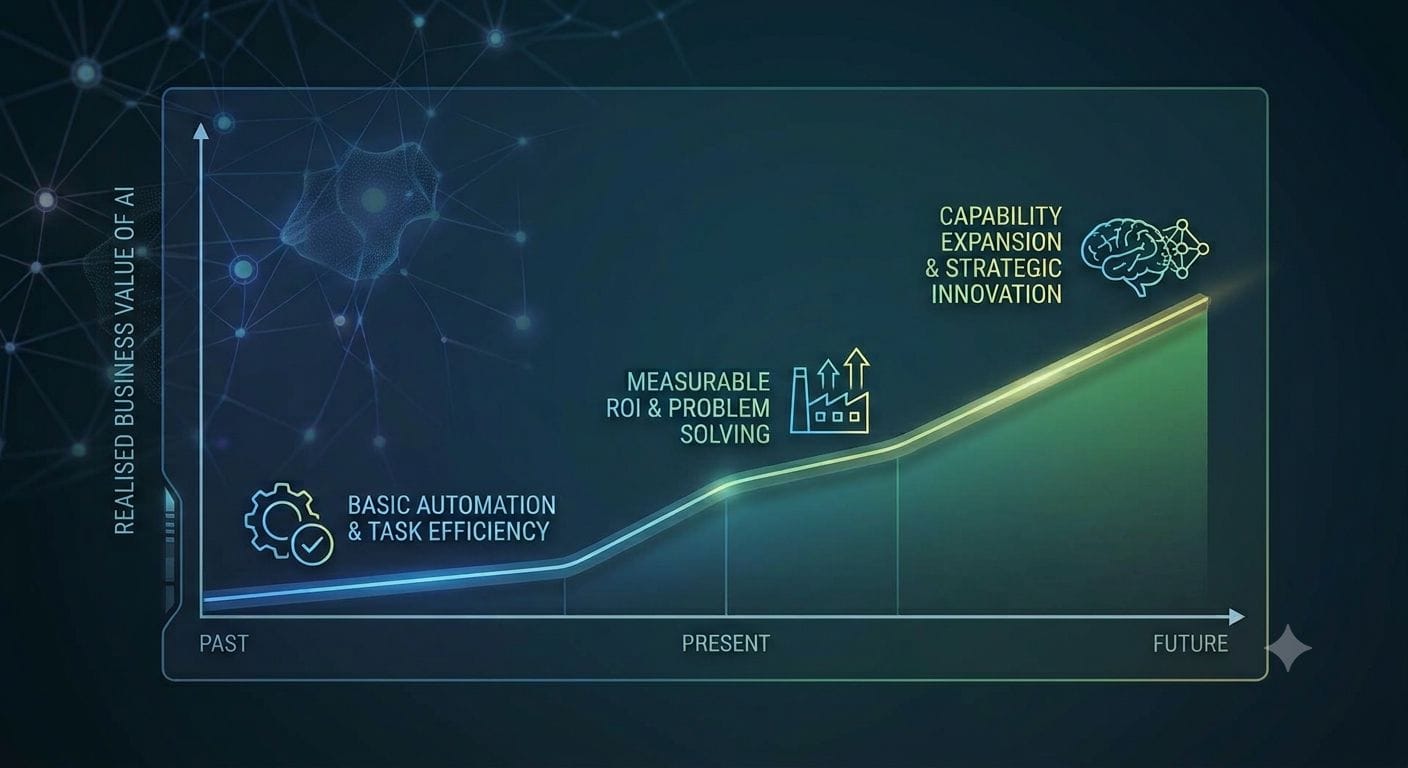
Many AI implementations focus on workforce reduction and process automation, which is understandable. Automation is measurable, familiar and easy to explain. Used well, AI can reduce repetitive work, speed up administration and improve productivity.
But that is only part of the opportunity.
The larger question is not just how much work AI can remove, but how much better work it can enable.
Can researchers explore more ideas and move faster from discovery to application? Can engineers solve harder problems? Can universities accelerate research impact? Can organisations capture expertise that would otherwise be lost when experienced people leave?
The greatest gains may not come from replacing people, but from increasing the amount of meaningful work people can accomplish.
That shifts the return-on-investment question from labour substitution to capability expansion. It asks not only whether AI can make existing processes cheaper, but whether it can help organisations do things they couldn’t previously do.
The future is not just bigger models
The future of AI is unlikely to be defined only by the largest models.
We do not need the most powerful model on Earth answering every question. We need systems that understand an organisation’s own data, context, risks and objectives. Increasingly capable local models running on-premises or on edge devices will have an important role, supported by larger cloud-based models when extra capability or broader context is required.
The term “AI” has been used since the 1950s, but not so much for a single technology, but rather the frontier of machine capability. As each breakthrough becomes commonplace, it quietly stops being described as AI, and becomes part of ordinary software. As novelty fades, what remains is whether it helps people and organisations achieve something useful.
The test is lasting impact
The metrics we use to judge AI also need to mature.
Model size, adoption numbers, token usage and benchmark performance may all tell us something. But they can become vanity metrics if they are detached from genuine outcomes.
The better questions are more demanding. Has AI helped create new products, better services, faster research, stronger organisations or more resilient industries? Has it improved decision-making? Has it helped people solve problems that matter?
AI will become yet another layer in the technology stack rather than a category unto itself. When that happens, success will be measured less by the size and capability of the models, but by a simpler question:
“Has the technology helped create something of lasting value?”
