
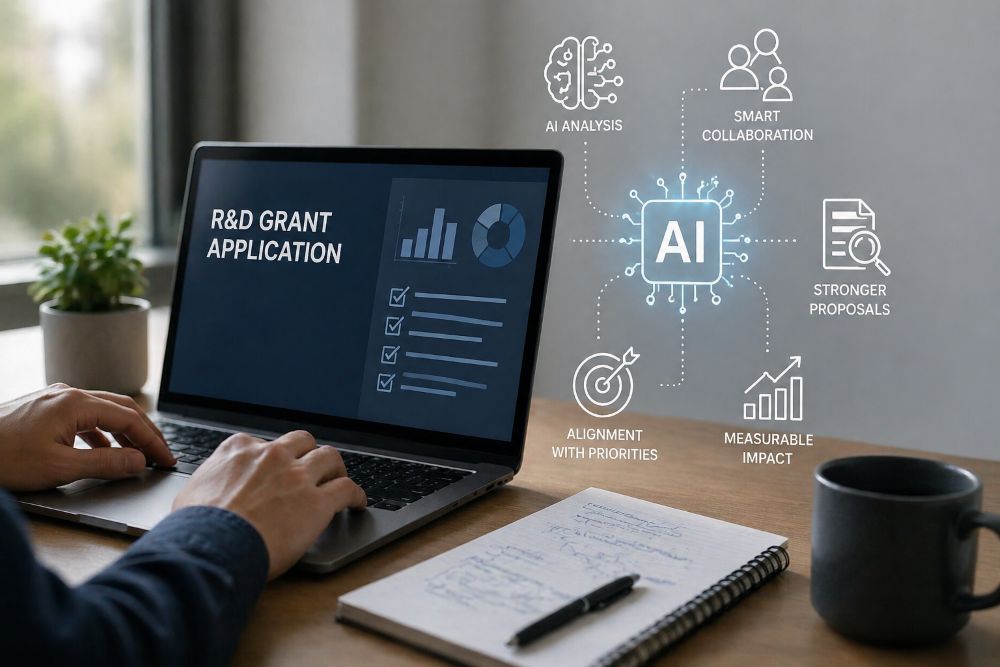
Australia’s R&D grant landscape is shifting quickly. For universities and industry partners, the old playbook of lengthy applications, rigid criteria, and slow feedback loops is being reshaped by artificial intelligence (AI). What was once a compliance-heavy process is becoming more dynamic, data-driven, and strategic.
From paper trails to data pipelines
Traditionally, applying for R&D funding in Australia meant navigating dense guidelines, aligning with government priorities, and investing significant time in submissions. While those fundamentals remain, AI is streamlining the mechanics behind the scenes.
Some grant administrators already use AI to assess applications at scale, flag inconsistencies, and identify high-potential projects based on historical patterns. For applicants, clarity and precision now matter more than ever, as vague claims and generic language are easily identified and deprioritised. In contrast, clearly articulated impact, measurable outcomes, and tight alignment with program objectives stand out.
Smarter applications, not just faster ones
Universities and companies are using AI tools to support drafting and testing proposals against criteria – but speed is only part of the benefit. AI can identify logic gaps, highlight missing evidence, and suggest stronger ways to frame collaboration and impact. It can also benchmark proposals against successful past applications.
However, balance is critical. Over-reliance on AI produces polished but generic proposals. In a competitive environment, originality, subject-matter expertise, and narrative are crucial. The strongest applications combine human insight with AI-assisted clarity.
Collaboration is becoming more targeted
Collaboration between universities and industry has been historically driven by networks or convenience. Now, AI tools can map expertise, identify complementary capabilities, and suggest partnerships based on publication data, patents, and project outcomes.
This is particularly valuable for identifying long-term partners and for large, multidisciplinary grants where alignment is critical. Instead of casting a wide net, teams can build more targeted partnerships from the outset.
Compliance, transparency, and risk
With AI in the mix, transparency and accountability are becoming more important. Funding agencies are increasingly focused on how AI is used in the application process, particularly around authorship, originality, and data integrity. ARC and NHMRC recently announced updated guidance on the use of generative AI by applicants and assessors.
At the same time, AI can support compliance. Automated checks for eligibility, budget alignment, and reporting requirements can reduce administrative burden and minimise risk
Human expertise still wins
AI hasn’t replaced the need for people who understand how to craft a winning proposal. If anything, it has made that expertise more valuable.
Experienced grant writers and strategists do more than assemble information. They shape narrative, align technical detail with funding priorities, and anticipate how assessors will interpret each section.
AI can generate content and flag gaps, but it doesn’t inherently understand nuance: the subtle differences between programs, the unspoken expectations of assessors, or the broader policy contexts that influence funding decisions.
Without the human layer, applications risk being technically sound but unconvincing.
How to use AI
As AI becomes embedded in grant writing, knowing how to use it effectively is becoming a key differentiator.
Do:
- Learn how to prompt AI effectively using specific criteria, guidelines, and context
- Use the most appropriate AI model for your grant or task (they are not all the same)
- Use AI to stress-test your logic, not replace it
- Use AI for editing, structuring, and gap analysis
- Cross-check outputs against program objectives and evidence
Don’t:
- Submit unedited AI-generated content
- Rely on generic prompts that produce generic responses
- Assume AI understands nuances across different grant schemes
- Ignore disclosure, confidentiality or integrity considerations
In terms of tools, a mix is emerging. Generative AI tools based on large language model (LLM) technology support drafting and refinement, while specialist AI platforms can map collaborators, analyse prior grants, and benchmark success patterns.
Some organisations are also building internal AI models trained on past submissions to generate more tailored insights. Used well, these tools act as a second set of eyes.
What next?
We’re still in the early stages of this AI transition, but the direction is clear. AI will continue to shape how grants are awarded and how they’re pursued.
Done right, AI can make the system more efficient, accessible, and impact-driven. But it also raises the bar – the era of ‘good enough’ applications is fading. For those willing to adapt and think strategically about how AI fits into their R&D approach, the changing landscape offers a real advantage.
Agencies like gemaker offer the blend of human expertise with smart tooling: deep familiarity with grant frameworks combined with the ability to leverage AI in a targeted and effective way.
In this new AI-enabled landscape, the winners won’t be those who rely solely on automation, but those who know how to pair it with experienced human judgment.
